

D. Dynamic Maps
These movies show how posting-derived task, skill, and AI signals move across occupational space in the NLx corpus. They are exploratory visualizations of change at work: useful for seeing structure, diffusion, and bridges across SOC groups, but not a substitute for pair-level validation or a causal model of occupational change.
Reading The Movies
Static guide. LLM-validated task-pair map, no rim
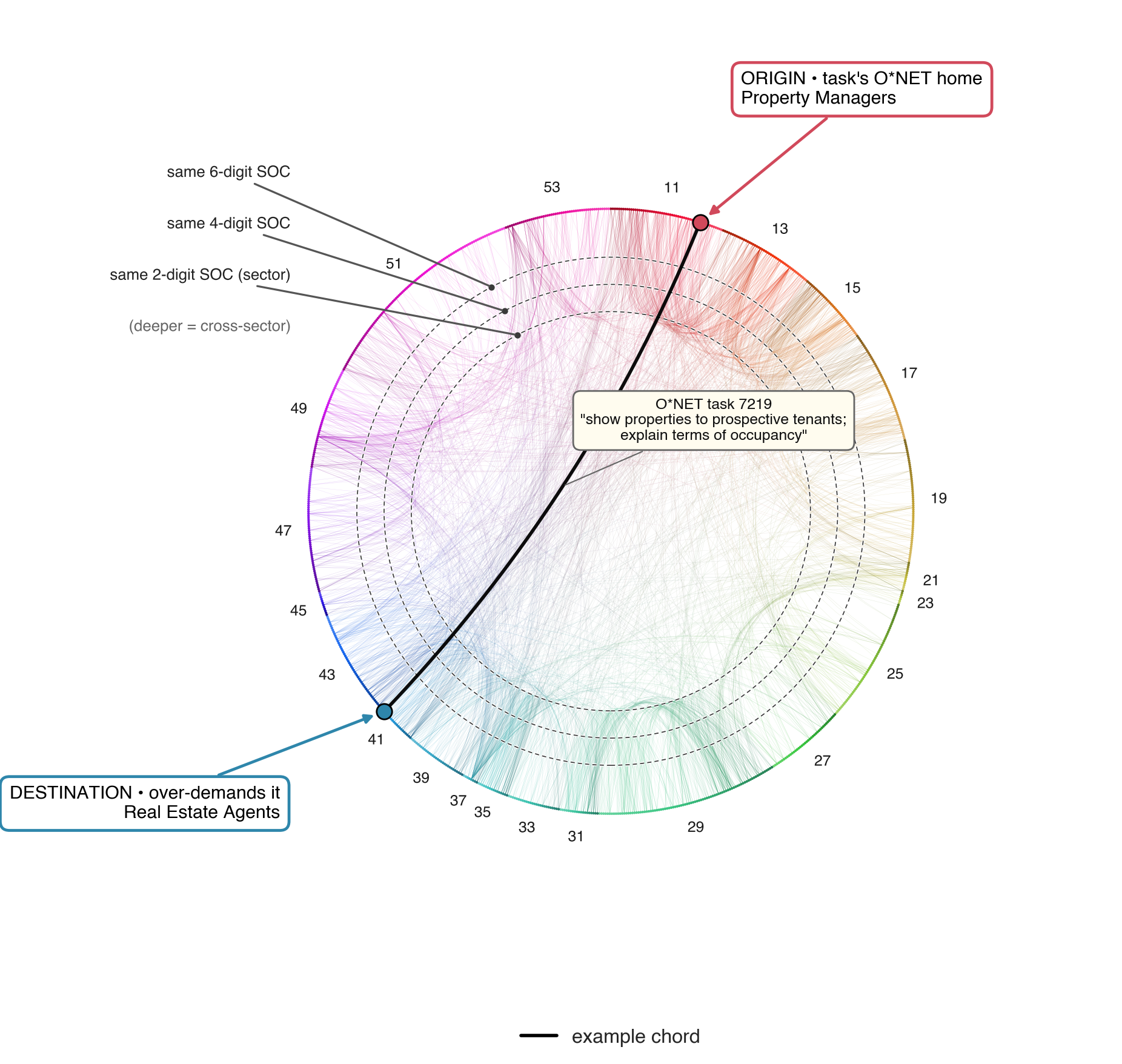
Occupations are arranged around the circle by SOC family, and chords connect occupational groups with shared or moving posting-derived signals. The no-rim view keeps attention on cross-occupation links rather than marginal bars.
Two quantities are doing different jobs here:
- RCA > 1 means a task, skill, or AI code is overrepresented for an occupation relative to the corpus baseline. It is a feature-level screen: this occupation uses the signal more than expected.
- Relatedness is a pair-level score. Two occupations are more related when they share more RCA-screened feature evidence, scaled so broad generic features do not dominate every edge.
In short, RCA says "this occupation lights up for this signal." Relatedness says "these two occupations share a meaningful bundle of overrepresented signals."
LLM-Validated Task Pairs
LLM-validated occupation-task pairs, no rim
This movie uses reviewed occupation-task evidence rather than all raw task matches. It shows where LLM-validated task demand appears across occupational families over time, emphasizing the chords and their movement.
The LLM-validated task-pair view is closest to the occupation-task-pairs analysis. It is narrower than an all-task movie because the displayed links have passed the review procedure used for the public task-pair evidence. It is still a posting-derived map: a link can reflect genuine task sharing, taxonomy narrowness, noisy occupational coding, or shifts in which employers appear in the corpus.
Related Occupation Maps
Related-occupation movies use shared RCA-screened evidence to place occupation pairs in a common map. The goal is not to say that one occupation becomes another. The goal is to show which occupations repeatedly share distinctive posting signals.
LLM-validated task relatedness
Pairs are built from LLM-validated task evidence. This is the most conservative task-map variant because it uses reviewed task pairs rather than the full task dictionary.
ESCO skill relatedness
Pairs are built from shared ESCO skill evidence in postings. ESCO skills are broader than task statements, so this view is good for seeing large neighborhoods and bridges, but individual edges can be driven by generic skill language.
Strict AI relatedness
Pairs are built from strict AIMatch code evidence. The strict filter is sparse but cleaner: it highlights occupations that share more specifically AI-related posting language.
STEM task bundle
Frames use a rolling window of NLx postings and a reviewed bundle of STEM-related task statements. Chords show where those task statements are overrepresented across occupations, without treating the canonical O*NET home as the only place the task can appear.
Lenient AI map
The lenient AIMatch layer is broader than the strict AI layer, so it is useful for seeing adjacent frontier language and early diffusion while remaining provisional.
Interpretation Limits
These maps are best read as exploratory measurement tools. Three limitations matter most.
First, occupational coding is imperfect. SOC or OCC6 assignment error can create false bridges or hide real ones, especially when postings are vague, multi-role, or mapped from employer titles into standard occupation codes.
Second, the NLx corpus changes over time in ways that are not fully observed. Employer participation, job-board coverage, posting composition, and occupational mix can all shift. A new chord can reflect changing demand, changing coverage, or both.
Third, broad dictionaries behave differently. ESCO skills and lenient AI-adjacent labels are useful for seeing wide neighborhoods, while LLM-validated tasks and strict AI are cleaner for pair-level interpretation. These movies are retained as exploratory visualizations of change at work rather than as a full edge-audit page.
Evidence Path
LLM-validated task-pair evidence is documented in A New Map of Work and Agreement And Audit Trail. AI-score validation is summarized in Finding Emerging Skills.
Audit Downloads
Show figure asset sources
/dynamic-maps/validated-task-map-norim.png: static no-rim guide image./dynamic-maps/validated-task-pairs.mp4: validated occupation-task pair movie./dynamic-maps/related-validated-tasks.mp4: related occupations from LLM-validated task evidence./dynamic-maps/related-esco-skills.mp4: related occupations from ESCO skill evidence./dynamic-maps/related-ai-strict.mp4: related occupations from strict AIMatch evidence./dynamic-maps/stem-task-bundle.mp4: STEM task-bundle movie from reviewed STEM-related task statements./dynamic-maps/ai-lenient.mp4: lenient AIMatch movie for broader AI-adjacent signals.